
Table of Contents
- Purchase Mint Never Hinged Stamps: What Serious Buyers Need First
- How to Identify Mint Never Hinged Stamps Before You Pay
- Mint Hinged vs Never Hinged Stamps: Why the Gap in Price Is Real
- Mint Stamp Value Guide: Pricing Beyond Face and Catalog Value
- Buying Stamps From Reputable Dealers: Due Diligence Checklist
- MNH PRC Stamps by Budget: Singles, Blocks, and Lots Compared
- Packing, Shipping, and Storage for MNH Stamps
- Frequently Asked Questions
Last Updated: October 13, 2026
Purchase Mint Never Hinged Stamps: What Serious Buyers Need First
To purchase mint never hinged stamps is to buy philately's closest thing to a time machine: a stamp that left the printer, sat untouched for decades, and still carries every fibre of its original gum. At PRC China Stamps, we have handled PRC issues from 1949 through 2007 long enough to know a listing's label is only a claim until the gum confirms it.
A single hinge mark, trace of gum disturbance, or re-gummed surface can cut a stamp's market standing dramatically, often invisibly in a thumbnail photo.
How to Identify Mint Never Hinged Stamps Before You Pay
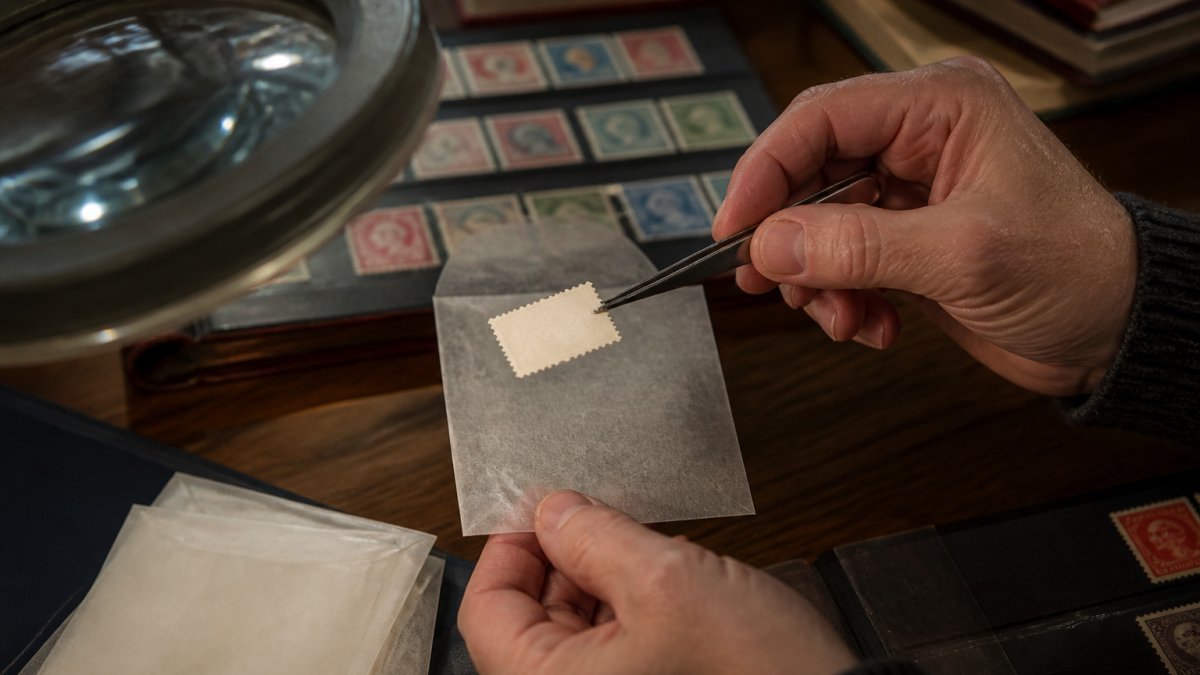
Most guides stop at the definition. This one gives you the inspection routine that separates a genuine MNH stamp from a hopeful description.
The Five-Point Gum Inspection
Work through these in order, under a bright, angled light. A desk lamp held to the side reveals texture that flat overhead light hides.
- Colour and consistency. Original gum on PRC issues from 1949-2007 is typically even in tone and slightly glossy. Lighter, darker, or matte patches are the first warning sign.
- Texture under raking light. Tilt the stamp so light skims the gum. Original gum has a fine, uniform surface; a hinge mark shows as a dull, flattened patch, faint rectangular shadow, or thin strip. Regummed areas often look too smooth, too glossy, or wavy at the edges.
- Edges and perforations. Original gum usually stops cleanly at the perforations. Gum bleeding over the perforation tips or looking brushed on points to regumming.
- Smell and feel (in person only). Original gum on older stamps has a faint, dry paper smell; freshly applied gum or a chemical odour is a red flag. Never touch gum with bare fingers, use tongs and handle by the perforations.
- The hinge-mark test. A true hinge mark is a disturbance, not just a stain: a small dull spot, thin band, or faint rectangle where a hinge was moistened and pressed. Any of these means the stamp is mint hinged or worse, regardless of the listing.
Reading a Listing Like an Inspector
When you read a listing, look for these signals:
- "MNH" or "never hinged" stated explicitly, not implied by the word "mint"
- Gum described as original, with any disturbance named rather than glossed over
- Clear images of the reverse, not just the face
A common mistake is trusting "mint" alone, in the trade it can mean mint hinged, and the price gap is real.
Red Flags That Suggest Regumming or Misdescription
Regumming, applying a new gum layer to mimic original gum, is the most common way a hinged or damaged stamp is passed off as MNH. Watch for:
- Gum that looks uniformly glossy across a stamp that should show age
- Gum extending over perforation tips or onto paper edges
- A reverse cleaner and newer than the front
None of these prove regumming alone, but together they justify asking for better images, a return policy, or a second opinion before you pay.
When to Ask for a Second Opinion
For low-value singles, your own five-point check is usually enough. For early PRC issues, key dates, or anything priced in the tens of dollars and up, ask for angled reverse images or have the stamp reviewed by a specialist or recognised expertising service before purchase. A dealer who has handled PRC material for decades will expect the question and answer it directly.
Mint Hinged vs Never Hinged Stamps: Why the Gap in Price Is Real
Mint hinged stamps carry a hinge mark; never hinged stamps do not. That single difference changes how a stamp sits in a collection and how it prices against its peers.
Hinges were the standard mounting method for generations: collectors moistened a small gummed strip, fixed it to the album page, and pressed the stamp onto it.
Never hinged material is scarcer because fewer stamps survived unmounted.
Mint Stamp Value Guide: Pricing Beyond Face and Catalog Value
Face value means almost nothing for PRC stamps from this era. Catalog value is an asking benchmark, not a market price, what a stamp actually sells for depends on condition, scarcity, and demand.
Work through value in this order:
- Condition first. Grade, centring, gum status, and the absence of faults set the ceiling.
- Catalog value second. Use it to frame the range, then discount for anything less than superb.
- Asking price third. Compare it against the catalog figure and against recent sales you can find.
- Accepted offer last. What a seller accepts is the truest number you will get.
Our own MNH stock runs from singles under a dollar to multi-stamp sets in the low tens. A PRC 2108 MNH single sits at $0.75, while a PRC 5-7 MNH Reprint is $11.50, scarcity, not face value, drives the number.

| Buying Goal | Typical Price Band | What to Expect |
|---|---|---|
| Filling gaps in a modern set | Under $1 to $2 | Single MNH stamps, common issues |
| Building short sets | $3 to $6 | 4 to 6 stamp MNH sets |
| Reprints and scarcer singles | $10 to $15 | Lower stock, higher demand |
| Early PRC and Cultural Revolution | Varies widely | Ask for grading detail before buying |
Buying Stamps From Reputable Dealers: Due Diligence Checklist
Reputable dealers describe condition precisely, show the reverse, answer grading questions, and stand behind what they sell. Run this checklist before any purchase:
- Does the seller state MNH explicitly and describe the gum?
- Are reverse images provided, front and back, in focus?
- Is the country of origin and catalog reference named?
For background on how the market treats condition grading, the American Philatelic Society's guidance on stamp grading is a useful reference, and the Smithsonian National Postal Museum maintains material on the history behind the issues themselves.
MNH PRC Stamps by Budget: Singles, Blocks, and Lots Compared
The right purchase depends on your goal, not your wallet alone. Singles fill specific gaps, blocks show the printing, and lots give you volume to sort through, decide which job you are hiring the stamp to do before you look at prices.
Match the Format to the Goal
- Singles fill a named gap in a run or set. You pay for precision, not volume.
- Sets and short runs build a defined period, such as a modern commemorative run. Buying the set together is usually cheaper than assembling it stamp by stamp.
- Blocks and multiples show the printing, margins, perforations, plate characteristics, and hold together as a unit for dealers.
Match the format to where you actually are.
A Structured Buying List by Budget and Goal
Here is how our current MNH stock breaks down by budget and use case:
| Item | Price | Best For |
|---|---|---|
| PRC 2108 MNH | $0.75 | First MNH purchase, gap filling |
| PRC 2103 MNH | $0.95 | Building a modern run |
| PRC 2116 MNH | $1.20 | Single-stamp collectors |
| PRC 2109 MNH | $1.45 | Filling a specific gap |
| PRC 2121-24 MNH | $1.80 | Four-stamp set, good value |
| PRC 2104-07 MNH | $3.75 | Short set building |
| PRC 2126-29 MNH | $4.10 | Set collectors |
| PRC 2117-20 MNH | $4.20 | Completing a run |
| PRC 2110-15 MNH | $5.45 | Six-stamp set, strong value |
| PRC 5-7 MNH Reprint | $11.50 | Reprint collectors, scarcer stock |
Read the table by goal, not price alone:


- Under $2, first purchase or gap filling. Buy one or two singles to learn how MNH gum looks and feels in hand. The PRC 2108 MNH at $0.75 is a low-risk entry point.
- $2 to $6, set building. Short sets and four- to six-stamp runs give you more of a period in one purchase; the PRC 2110-15 MNH six-stamp set at $5.45 is the strongest value in this band.
- $10 and up, reprints and scarcer singles. Lower stock, steadier demand. The PRC 5-7 MNH Reprint at $11.50 suits collectors who know the difference between an original and a reprint and want the reprint specifically.
How to Sequence Your First Three Purchases
A pattern that works for most new MNH buyers:
- Buy one low-cost single and inspect the gum yourself against the five-point check above. This calibrates your eye.
- Buy one short set in the $2-$6 range to see how a matched run looks together and to test the seller's packaging and shipping.
- Then chase the specific gap you care about, whether a single, a set, or a reprint.
This sequence costs little, teaches you the seller's standards, and prevents overpaying for early material before you can judge it. Collectors with a specific 1949-1952 gap should ask directly, if we do not have it in stock, we can often source it.
Packing, Shipping, and Storage for MNH Stamps
Gum is fragile: heat, moisture, and pressure damage it faster than almost anything else, and transit damage is the most common complaint buyers bring to any dealer.
Our approach is simple: stamps travel in a rigid holder, protected from bending, sealed against moisture, and packed so nothing shifts. Combined shipping applies across multiple lots. For storage at home, follow the same logic:
- Keep stamps in a cool, dry place away from direct sunlight
- Use proper mounts rather than hinges if you intend to keep MNH condition intact
- Store albums upright, not stacked, to avoid pressure on the gum
If you want to understand how humidity affects paper and gum over time, the Library of Congress guidance on preserving paper collections covers the environmental factors in detail.
Buying MNH stamps without regret comes down to verification, patience, and a seller who answers questions properly.
Frequently Asked Questions
What does mint never hinged mean in stamp collecting?
Mint never hinged (MNH) describes an unused stamp whose original gum is fully intact and shows no hinge mark. A hinge is the small gummed strip collectors once used to mount stamps in an album, and it leaves a visible residue or thin spot when removed. MNH is the top condition tier for unused stamps, which is why MNH listings command higher asking prices than mint hinged or unused-no-gum copies of the same issue.
How can you tell if a stamp is truly mint never hinged?
Tilt the stamp under a bright lamp and study the gum side at an angle. Original gum should be evenly distributed with no rectangular residue, no dull patch, and no thinning. A hinge mark usually shows as a faint brown or shiny band near the top. Ask the seller for a clear photo of the reverse before you buy, and confirm the condition description in writing so you have recourse if the stamp arrives hinged.
Are mint never hinged stamps worth more than hinged stamps?
Yes, and the gap widens with age and scarcity. For many classic PRC issues, an MNH example can sell for a multiple of the same stamp in mint hinged condition because MNH is the standard serious collectors and investors target. When you compare listings, always check whether the price reflects the grade and gum status, not just the catalog number, or you may pay MNH money for a hinged stamp.
Where can I buy authentic mint never hinged stamps?
Buy from a dealer who specializes in the area you collect and who states gum status explicitly on every listing. PRC China Stamps focuses on MNH stamps from the People's Republic of China, 1949 to 2007, with individual stamps and sets listed at fixed prices. Specialists can answer condition questions directly, which is harder to do on general marketplaces where the same catalog number appears under a dozen different condition descriptions.
How should MNH stamps be shipped and stored?
Ask how the seller packs before you order. Stamps should travel in glassine or a rigid holder, sandwiched between stiff boards, inside a waterproof outer envelope. Once they arrive, keep MNH stamps in a dry, dark place, away from heat and humidity, using acid-free stock pages or a quality album. Never tape or hinge an MNH stamp into place; mounts protect the gum and preserve the condition you paid for.