
Table of Contents
- Why Accurate Grading Matters for PRC Stamp Collectors
- The Core Stamp Grading Criteria Every Collector Should Know
- Stamp Centering and Margins: Judging the Design's Placement
- Mint Never Hinged Stamp Gum: What to Look For
- Spotting Stamp Faults and Defects During Inspection
- A Step-by-Step Workflow to Grade PRC Stamps Accurately
- Grading vs. Authenticity: Knowing the Difference
- Conclusion
- Frequently Asked Questions
Last Updated: October 18, 2026
Why Accurate Grading Matters for PRC Stamp Collectors
Learning how to grade PRC stamps accurately is the single most useful skill a collector of Chinese philately can build. It protects your money, sharpens your eye, and lets you compare one unused stamp against another on equal terms. At PRC China Stamps, we specialize in Mint Never Hinged (MNH) stamps from the People's Republic of China, covering 1949-2007.
Two stamps can share the same catalog number and sit at very different points on the value curve. A well-centered example with clean gum draws serious interest. A creased or re-gummed copy of the same issue often sits unsold.
Grade is also how you talk to other collectors. "Very Fine" means something specific. So does "sound." When both sides of a trade use the same terms, negotiation gets faster and fairer.
Below, we walk through the criteria, the tools, and a repeatable workflow you can use on every stamp that crosses your desk. The goal is consistency: the same stamp graded twice should land in the same place.
The Core Stamp Grading Criteria Every Collector Should Know
Stamp grading rests on four pillars: centering, soundness, gum, and cancellation. Each one is assessed on its own, then combined into an overall grade. Skipping any pillar produces a grade you cannot defend.
Here is how we break them down:
- Centering: how the design sits inside the perforations
- Soundness: whether the paper is free of faults
- Gum: the state of the original adhesive on unused stamps
- Cancellation: the quality and placement of the postmark on used stamps
The first two apply to every stamp. The last two depend on whether the stamp is unused.
A common mistake is letting one strong pillar carry the whole grade. A perfectly centered stamp with a hidden thin is not Very Fine. It is a faulty stamp with nice centering, and it should be described that way.
From Fine to Very Fine: The Grading Scale Explained
Most collectors work with a short scale. Fine describes a stamp with average centering and no serious faults. Very Fine means well-centered with clean soundness. Extremely Fine sits at the top, with near-perfect centering and pristine condition.
Below Very Fine, you will also see Very Good, Good, and Average used for stamps with visible wear or off-center designs. The exact boundaries vary between dealers and auction houses, so always ask which scale a seller uses before you compare prices.
Stamp Centering and Margins: Judging the Design's Placement
Centering is the fastest thing to judge and the hardest to fake. Look at the four margins between the design and the perforations. If all four are roughly equal, the stamp is well-centered. If one side is noticeably tighter, the grade drops.
A practical method: flip the stamp over and sight along each edge. Your eye catches uneven margins faster from the back. Then turn it face up and confirm.
Watch for these patterns:
- Even on all four sides: the strongest centering grade
- Slightly tight on one side: still collectible, grade drops a notch
- Design touching or cut into by perforations: a serious centering fault
Margins matter because they cannot be fixed. A crease can sometimes be pressed out. Centering is permanent. That is why centering carries so much weight in the final grade.
Mint Never Hinged Stamp Gum: What to Look For
Mint never hinged stamp gum is the original adhesive on an unused stamp, undisturbed by hinges or mounts. "Never hinged" means no hinge has ever touched the back.
Under good light, original gum shows an even, slightly textured surface. Look for:
- Uniform color and sheen across the back
- No rectangular marks where a hinge once sat
- No glossy patches that suggest re-gumming
- No cracks or crazing in the gum itself
A hinge mark usually appears as a small rectangle of disturbed or missing gum. It is easy to miss on a quick look and obvious under raking light. Re-gummed stamps often look too smooth and too shiny compared with genuine examples from the same issue.
Spotting Stamp Faults and Defects During Inspection
Stamp faults and defects are where inexperienced graders lose money. Some are obvious. Others hide until you tilt the stamp toward a lamp.
Work through this fault list every time:
- Creases: look for a faint line that catches light at an angle
- Tears: check edges and perforation tips closely
- Thins: a thinner patch of paper, often invisible from the front
- Stains: rust, ink, or water marks that have soaked into the paper
- Perforation damage: short or missing teeth along the edge
- Color fading: uneven tone from light exposure
Thins are the sneaky one. Hold the stamp up to a bright lamp and look for a lighter patch where the paper is thinner. Many collectors miss thins on the front and only find them after purchase.
Perforation quality deserves its own pass. Run your eye along every edge and count the teeth. A missing tooth is a fault, even on an otherwise clean stamp.
A Step-by-Step Workflow to Grade PRC Stamps Accurately
A repeatable workflow is what separates a careful grade from a guess. Use the same sequence every time, and record your findings as you go.
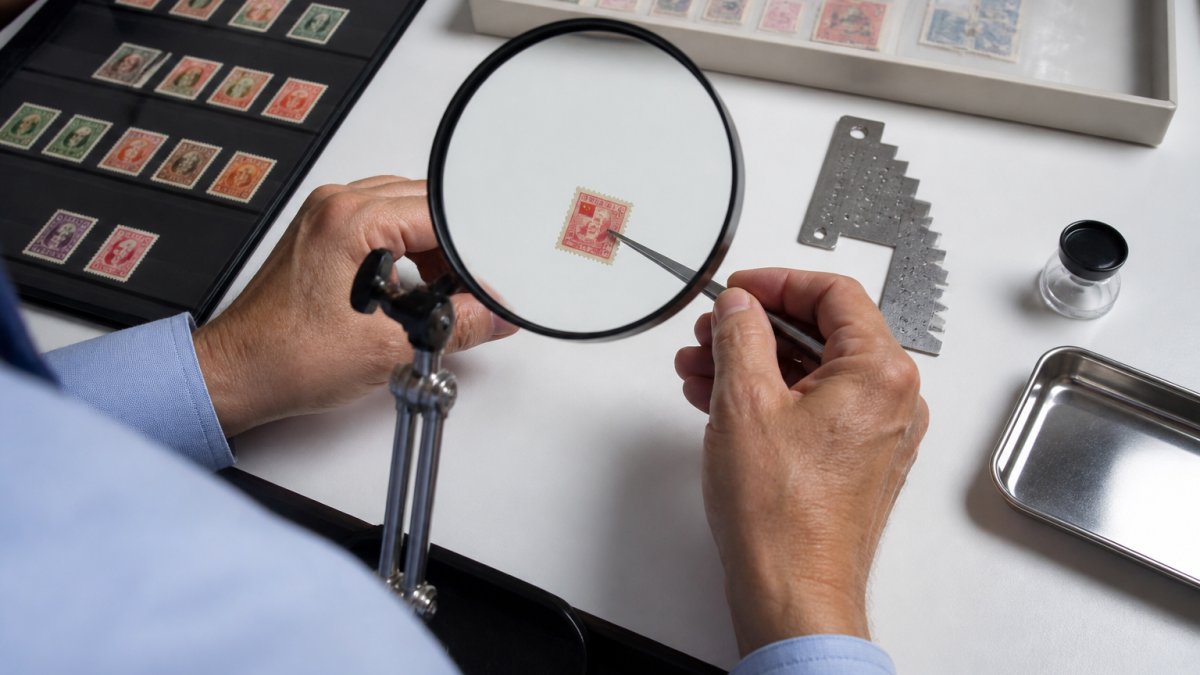
Step 1: Set up your workspace. Work on a clean, uncluttered desk with a bright desk lamp that can be angled for raking light. Keep food, drink, and ink away from the work area.
Step 2: Handle with tongs. Never touch a mint stamp with bare fingers. Skin oils transfer to paper and gum and cannot be removed without damaging the stamp. Use quality stamp tongs with smooth, rounded tips.
Step 3: Check centering. Sight all four margins from the back first, because uneven margins are often easier to spot when the design is reversed. Then turn the stamp face up and confirm.
Step 4: Inspect soundness. Tilt the stamp under raking light to catch creases. Hold it up to a bright lamp to look for thins, which appear as lighter patches where the paper is thinner.
Step 5: Assess gum (unused only). Under good light, look for hinge marks, re-gumming, and gum disturbance.
Step 6: Assess cancellation (used only). Note postmark clarity, placement, and whether the cancellation is contemporaneous with the stamp's period of use.
Step 7: Record your findings. Write down each pillar separately, then assign an overall grade. Include the date, the catalog number if known, and any faults you observed.
Tools and Safe Handling for Stamp Inspection
You do not need much, but the few tools you do need matter:
- Stamp tongs: the single most important tool. Buy a quality pair with smooth tips and use them for every stamp.
- Magnifying glass: 10x is enough for most inspection work. Higher magnification can be useful for fine perforation and paper detail but reduces the field of view.
- Perforation gauge: confirms perforation size and helps spot trimmed or re-perforated edges.
- Bright desk lamp: raking light reveals creases and thins that are invisible under direct light.
- Black card stock: a dark background makes margins and perforations easier to see.
- Watermark fluid and tray (optional): useful for checking paper and watermark on some issues, but use only in a well-ventilated area and follow safe-handling guidance.
Store graded stamps in acid-free mounts or stock cards. Keep them away from heat, sunlight, and humidity. A stamp graded Very Fine today can degrade fast in poor storage. Handle stamps over a clean surface so that a dropped stamp does not land on a hard floor or disappear into a carpet.
Grading vs. Authenticity: Knowing the Difference
Grading and authenticity are two separate questions, and mixing them up is a costly error. Grading asks: what condition is this stamp in? Authenticity asks: is this stamp what it claims to be?
A stamp can be genuinely Very Fine and still be a forgery. A genuine stamp can be heavily faulty. Neither answer tells you the other. This distinction matters more for PRC material than for many other collecting areas, because the market includes reprints, unofficial reproductions, and altered stamps that can look convincing to an untrained eye.
Authenticity work covers paper type, printing method, color, perforation measurements, watermark, and postal history. That is specialist territory. For high-value PRC material, an expertizing certificate from a recognized body is worth pursuing. A certificate confirms authenticity; a grade describes condition. Ask for both when the money is serious.
A condition grade does not establish genuineness. A dealer or collector can assign a grade based on centering, soundness, gum, and cancellation, but that grade says nothing about whether the stamp was printed by the intended authority. Conversely, an expertizing certificate may confirm authenticity without assigning a condition grade.
When should you seek expert review? Consider it when the stamp is high-value, when the issue is known to have been reproduced or altered, when the paper or printing looks inconsistent with known examples, or when the seller cannot provide provenance.
| Question | What It Answers | Who Handles It |
|---|---|---|
| Grading | What condition is the stamp in? | Collector or dealer |
| Authenticity | Is the stamp genuine? | Expertizing service |
A practical rule: grade every stamp you handle, but reserve authenticity judgment for situations where the stakes justify specialist review. Recording your condition findings separately from any authenticity questions keeps your notes clear and makes it easier to decide when to seek expert help.
Conclusion
Grading PRC stamps accurately takes practice, but the method is simple: check centering, soundness, gum, and cancellation in the same order every time, and write down what you see. That discipline is what separates a confident buyer from a hopeful one.
If you want stamps that already meet a high bar, our inventory at PRC China Stamps focuses on Mint Never Hinged examples from 1949-2007. Every stamp is handled with care, and our knowledgeable team can help you find the philatelic treasures you seek. Search our collection and find the gaps you have been chasing.
Frequently Asked Questions
How do I know if a PRC stamp is in good condition?
Check four things in order: centering, gum, perforations, and faults. A good-condition PRC stamp has a design that sits reasonably within its margins, intact perforations with no missing teeth, clean paper with no tears, creases, thins, or stains, and, if unused, original gum that shows no hinge marks. Examine the stamp under good light with a magnifier and compare it against a known reference copy. If any single factor is borderline, downgrade your assessment rather than rounding up.
How does centering affect a PRC stamp's grade?
Centering is often the deciding factor between one grade and the next. A stamp whose design is centered evenly within the perforations, with margins of similar width on all four sides, grades higher than an otherwise identical stamp that is noticeably off-center. When you grade PRC stamps, measure the margins by eye against the perforation tips on each side. A well-centered example can move up a full grade compared with a poorly centered one, even when gum and perforations are equal.
Can a stamp be mint never hinged if its gum is disturbed?
No. Mint never hinged means the original gum is undisturbed and shows no hinge remnant, hinge mark, or gum skip from a previous mount. If the gum has been hinged, thinned, or partially removed, the stamp is mint hinged or mint no gum, not never hinged. Under angled light, look for a small rectangular disturbance or a change in gum texture near the top edge. Any doubt about gum condition should be stated plainly when you describe or sell the stamp.
When should I ask an expert to assess a PRC stamp?
Ask for expert assessment when the stamp is high-value, when you suspect regumming or reperforating, when the cancellation or postmark looks questionable, or when your own grade would swing a full level depending on one fault. Expertizing also helps when you plan to sell and want a certificate to support your description. Grading yourself is fine for everyday sorting; for rare Cultural Revolution issues or early 1949-1952 sets, a second qualified opinion protects both your wallet and your reputation.