
Table of Contents
- Why Chinese Stamp Pricing Changed in 2026
- Chinese Stamp Values: What Drives the Numbers
- Valuable Chinese Stamps: The 2026 Price Breakdown
- Chinese Stamp Catalogue Values: How to Read Them
- How to Authenticate Chinese Stamps Before You Buy
- PRC China Stamps Price List: What $6.50 to $69 Buys
- Buying and Selling Chinese Stamps in 2026
- Frequently Asked Questions
Last Updated: October 16, 2026
Why Chinese Stamp Pricing Changed in 2026
Chinese stamp pricing in 2026 reflects a market where condition, authenticity, and catalog documentation matter more than ever.
The biggest change isn't price swings, it's scrutiny.
Chinese stamp pricing is the process of determining a stamp's market value based on catalog references, condition grade, rarity, and recent realized sales rather than seller asking prices alone.
Below, we'll show how to separate catalog estimates from real transaction values, authenticate before you buy, and spot the condition factors that multiply or destroy value.
Chinese Stamp Values: What Drives the Numbers
Four factors decide what a Chinese stamp is worth: rarity, condition, demand for the specific issue, and documentation.
A common mistake is assuming age equals value.
Demand concentrates in early PRC material from 1949 to the mid-1950s, Cultural Revolution issues, and complete matched sets.
Universal Postal Union philatelic resources notes that stamp documentation standards vary by issuing authority, which is why catalog references matter when you compare across markets.
Catalog Value vs. Realized Sale Price
Catalog value is a publisher's reference estimate of retail replacement cost, not a guaranteed sale price.
The gap can be wide. Catalog values function as a ceiling for common material and a starting benchmark for scarce material.
When evaluating a listing, ask which number you're looking at. If a seller quotes catalog value without mentioning condition or recent sales, treat it as a rough guide only.
| Value Reference | What It Represents | How to Use It |
|---|---|---|
| Catalog value | Publisher's retail estimate | Benchmark, not a promise |
| Asking price | Seller's requested amount | Compare across listings |
| Realized sale price | Actual completed transaction | Strongest signal of market value |
| Dealer buy price | What a dealer will pay you | Typically below retail |
Valuable Chinese Stamps: The 2026 Price Breakdown
Most guides list a handful of famous rarities and stop there, not useful when you're holding an actual stamp and need a number. Below is a structured, era-by-era price range organized the way collectors actually buy: by issuing period and category.
Treat every range as a market estimate, not a quote. Ranges reflect the spread between realized sale prices for average and strong examples in the same category.
Imperial China (1878-1911)
Imperial issues are the deepest end of the market. Common used Large Dragon and Small Dragon examples trade in the low hundreds, while well-centered mint examples with original gum routinely reach four figures. The 1897 Red Revenue surcharges are the classic variety-driven stamp: a common example and a scarce surcharge can differ by an order of magnitude.
Republic of China (1912-1949)
Republic-era material is the most uneven category. Common used definitives are inexpensive, often under $10, while scarce commemoratives, high denominations, and 1940s surcharges climb into the hundreds. The 1949 Silver Yuan issues and late-republic overprints hold most of the value, and most of the reprints and forgeries.
Early PRC (1949-1955)
This is the strongest demand zone for PRC collectors. Scarce MNH sets from the early commemorative runs routinely trade in the low hundreds, and complete matched sets command a premium over the sum of their singles. Used examples trade at a fraction of MNH value unless the cancellation is itself scarce. Reprints exist for several early issues and are frequently misrepresented as originals; always verify the reprint designation against the catalog.
Cultural Revolution and Late PRC (1966-1991)
Cultural Revolution issues combine historical significance with limited surviving supply. Common used examples sit in the low tens, while MNH examples of scarcer issues and complete sets climb into the hundreds. Late PRC material from the 1980s and 1990s trades in the low to mid tens for MNH sets, with a few scarce varieties breaking higher.
Modern PRC (1992-2007)
Modern PRC sets are widely available and affordable. Most MNH sets trade in the low tens, with value driven by completeness, condition, and the occasional scarce variety rather than age. This is the most practical category for new collectors.
Hong Kong and Treaty Ports
Hong Kong material spans a wide range. Common used Queen Victoria and King George issues are inexpensive, while scarce early issues, high denominations, and the Japanese occupation period climb sharply. Treaty port material is a specialist category where identification and authenticity carry most of the value.
What Separates a Common Stamp from a Scarce One
Three factors move a stamp from the low end of its category range to the high end:
- Printing variety: A watermark difference, a reprint, or a plate flaw can change the catalog number and the value entirely.
- Condition grade: A well-centered MNH example can be worth several times a hinged or off-center example of the same issue.
- Cancellation: A clear, scarce, or dated cancellation can lift a used stamp well above the typical used range.
MNH vs. Used: Why Condition Multiplies Value
Mint Never Hinged means the stamp retains full original gum with no hinge marks or prior mounting. Used means postally cancelled. Both are collectible, but MNH generally commands a premium because supply is smaller and condition is harder to preserve.
The premium isn't automatic: a heavily toned MNH stamp can be worth less than a crisp, well-centered used example. Grade and eye appeal decide the final number.
- MNH: Full gum, no hinge marks, no faults. Highest premium.
- Mint hinged: Original gum with hinge remnants. Moderate discount.
- Used: Cancelled. Value depends on cancellation clarity and scarcity.
Chinese Stamp Catalogue Values: How to Read Them
A catalog number identifies a specific stamp within a published reference system, the issue, the series, and often the printing variety.
Reading a catalog entry means checking four things: issue year, catalog number, listed varieties, and the condition assumptions behind the quoted value.
Smithsonian National Postal Museum resources maintains reference material on stamp production and printing methods that helps collectors understand why varieties exist.
How to Authenticate Chinese Stamps Before You Buy
Authentication comes down to four checks: paper and watermark, gum, perforations, and printing detail. Run all four before money changes hands.
Start with the watermark, holding the stamp against a light source or using watermark fluid.
When a stamp's value justifies it, get expert certification.
- Verify watermark against the catalog reference
- Inspect gum for evenness and original texture
- Measure perforations with a gauge
American Philatelic Society expertizing information explains how formal authentication works and when it's worth the cost.
PRC China Stamps Price List: What $6.50 to $69 Buys
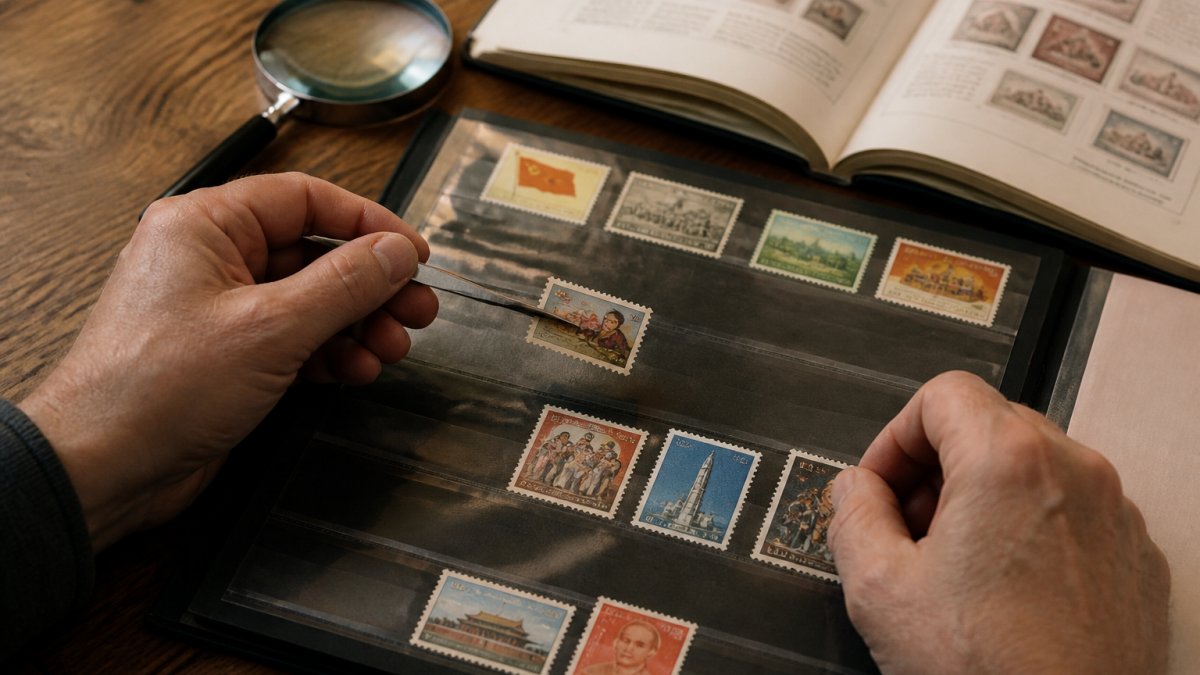
Our inventory shows how far a budget stretches across the 1949-2007 range.
| Item | Description | Price |
|---|---|---|
| PRC 21-23 | MNH set | $6.50 |
| PRC 82-84 | MNH set | $7.00 |
| PRC 5-7 Reprint | MNH reprint | $11.50 |
| PRC 49-56 | MNH set | $15.00 |
| PRC 141-150 Reprint | MNH reprint | $49.00 |
| PRC 249-266 | MNH set | $69.00 |
At the low end, PRC 21-23 at $6.50 and PRC 82-84 at $7.00 fill gaps without stretching a budget. Mid-range buyers often move to PRC 49-56 at $15.00, a solid MNH set with broad appeal.


For collectors building toward scarcer material, PRC 141-150 Reprint at $49.00 and PRC 249-266 at $69.00 represent the upper tier of our listings.
We also carry historical paper for collectors who cross over into banknotes, including a 1940 Bank of China 10 Yuan note at $12.00 and a 1936 Central Bank of China 100 Yuan note at $20.00.
Buying and Selling Chinese Stamps in 2026
Buying well comes down to three habits: buy the grade you can verify, buy from sellers who document both sides, and buy with a return option.
For buyers, the sequence is simple: identify the catalog number, confirm condition, check recent realized sales, then compare asking prices.
For sellers, presentation decides the outcome: note the catalog number, grade honestly, photograph the gum and watermark, and state your return terms.
How to Get a Reliable Appraisal
No top-ranking guide explains appraisal options, the most common question collectors ask after inheriting or acquiring a collection. There are three realistic paths, each serving a different purpose.
- Dealer appraisal: A reputable dealer can give a verbal or written estimate, often free or low-cost if you are considering selling to them. Useful for a quick sense of value, but treat it as a buy-side number, not a retail number.
- Auction house appraisal: Auction houses that handle philatelic material will often provide a pre-sale estimate for consignments. This is the closest thing to a market-based valuation, because the house has an incentive to price accurately.
- Formal expertization: For individual high-value stamps, a certificate from a recognized expertizing body confirms authenticity and detects repairs. This is not a valuation, but it is often required before a serious buyer will commit.
A practical rule: get a dealer or auction estimate first, then decide whether the value justifies the cost of formal expertization. For low-value material, certification costs more than it adds.
How to Spot Counterfeits and Misrepresented Stamps
Chinese stamps are among the most counterfeited in the hobby, and the 2026 market rewards buyers who know the warning signs: regumming, reperforating, reprints sold as originals, and forged cancellations.
Watch for these red flags:
- Gum that looks too glossy or too even. Original gum has texture and often slight unevenness. A perfectly uniform, high-gloss surface suggests regumming.
- Perforations with inconsistent spacing. Measure with a gauge. Reperforated stamps frequently show holes that do not line up with the expected count.
- A price far below the category range. A scarce issue offered at a common-stamp price is usually either faulty, a reprint, or a forgery.
Safe Selling Practices
If you are selling, protect yourself the same way you would as a buyer.
We facilitate June and November Chinese stamp auctions for collectors and dealers who want a competitive venue. Our inventory comes partly from a long-time investor liquidating holdings, ensuring fresh material reaches the market.
International Federation of Philately guidance on collecting outlines ethical standards that apply to buying, selling, and expertizing worldwide.
Frequently Asked Questions
How do I find out what my Chinese stamps are worth?
Start by identifying the issue and catalog number using a specialized PRC reference. Check recent realized sale prices, not just catalog values, because actual sale prices often run 40-60% below catalog for common material. Condition matters enormously: a Mint Never Hinged (MNH) stamp can be worth several times a used copy. For stamps from 1949-2007, compare your item against current dealer listings and auction results. If the stamp appears rare, get a written appraisal from a specialist before selling.
Which Chinese stamps are valuable to collectors?
The most valuable Chinese stamps tend to be early PRC issues from 1949-1952, Cultural Revolution sets, and scarce MNH examples with no hinge marks. Rarity, collector demand, and condition drive value more than age alone. Some later sets from the 1960s and 1970s also command strong prices when they are MNH and well-centered. Stamps with superb condition and gem quality centering consistently outperform average copies at auction.
Are mint never hinged Chinese stamps worth more?
Yes. MNH (Mint Never Hinged) stamps carry a premium because they retain original gum with no hinge marks or disturbances. For PRC stamps from 1949-2007, the MNH premium can be 2-5x the price of a hinged or used example. Collectors and investors prioritize MNH because it represents the highest grade available. When buying, always confirm the MNH designation in writing, and check for cancellation or regumming before you commit.
How can I tell whether a Chinese stamp is genuine?
Authentication starts with the basics: check paper type, watermark, printing method, and perforation measurements against a known reference. Reprints exist for many PRC issues, so compare gum color and texture carefully. A genuine MNH stamp should have undisturbed, evenly distributed gum. For high-value items, expert certification from a recognized philatelic body is worth the cost. Avoid sellers who cannot provide clear, high-resolution images of both front and back.
Do catalogue prices reflect what Chinese stamps actually sell for?
No. Catalogue values are retail asking prices, not realized sale prices. In practice, common PRC stamps often sell for 40-60% of catalog, while rare MNH examples can exceed catalog when demand is strong. Always cross-check against recent auction results and dealer listings before buying or selling. A 2026 pricing guide should separate estimate from asking price so you know what the market is actually paying.